
Cable Sizing Assessment
Time limit: 0
Quiz Summary
0 of 23 Questions completed
Questions:
Information
You have already completed the quiz before. Hence you can not start it again.
Quiz is loading…
You must sign in or sign up to start the quiz.
You must first complete the following:
Results
Quiz complete. Results are being recorded.
Results
0 of 23 Questions answered correctly
Your time:
Time has elapsed
You have reached 0 of 0 point(s), (0)
Earned Point(s): 0 of 0, (0)
0 Essay(s) Pending (Possible Point(s): 0)
Categories
- Not categorized 0%
- Review
- Answered
- Correct
- Incorrect
-
Question 1 of 23
1. Question
Question 1.1
The distance between the array junction box and inverter is {50} m. The array ISC current is {10} A and the MPP voltage is {520} V.
Choose the minimum cross-sectional area cable you can use, if the resistivity of the cable is 0.0219 Ω/m/mm2 and voltage drop must be kept below 1%.
CorrectIncorrect -
Question 2 of 23
2. Question
Question 1.2
The distance between the array junction box and inverter is 50 m. The array ISC current is 10 A and the MPP voltage is 520 V.
Of the following standard cable sizes, choose the smallest cable you can use while keeping below 1% voltage drop.
CorrectIncorrect -
Question 3 of 23
3. Question
Question 2
An array has an ISC current of {11} A and a MPP voltage of {560} V. The distance between the array junction box and the inverter is {62} m.
What is the voltage drop (V) in the array cable if you used 2.5 mm2 copper XLPE-90 cable (resistivity = 0.0219 Ω/m/mm2)?
CorrectIncorrect -
Question 4 of 23
4. Question
Question 3.1
An array has an ISC current of {11} A and a MPP voltage of {560} V. The distance between the array junction box and the inverter is {62} m.
What is the voltage drop (V) in the array cable if you used 2.5 mm2 copper XLPE-90 cable (resistivity = 0.0219 Ω/m/mm2)?
CorrectIncorrect -
Question 5 of 23
5. Question
Question 3.2
An array has an ISC current of {11} A and a MPP voltage of {560} V. The distance between the array junction box and the inverter is {62} m.
What is this voltage drop in percentage of the array MPP voltage?
CorrectIncorrect -
Question 6 of 23
6. Question
Question 3.3
An array has an ISC current of {11} A and a MPP voltage of {560} V. The distance between the array junction box and the inverter is {62} m.
Assuming you have already calculated a 1% voltage drop in the string cables, can you use 2.5mm2 copper cable for the array cable? Note the maximum recommended DC voltage drop according to AS/NZS 5033:2021 is 3%.
CorrectIncorrect -
Question 7 of 23
7. Question
Question 4
An array has an ISC current of {20} A and a MPP voltage of {255} V. The copper cable between the array and the inverter is a 6 mm2 copper cable with PVC-75 insulation. The distance between the array and the inverter is {30} m.
Choose one.
Resistivity for different cables at maximum temperature (Ω/m/mm2)
CorrectIncorrect -
Question 8 of 23
8. Question
Question 5
The image shows a module array with different cabling arrangements. Choose the most appropriate options for a rooftop installation to minimise inductive loops.
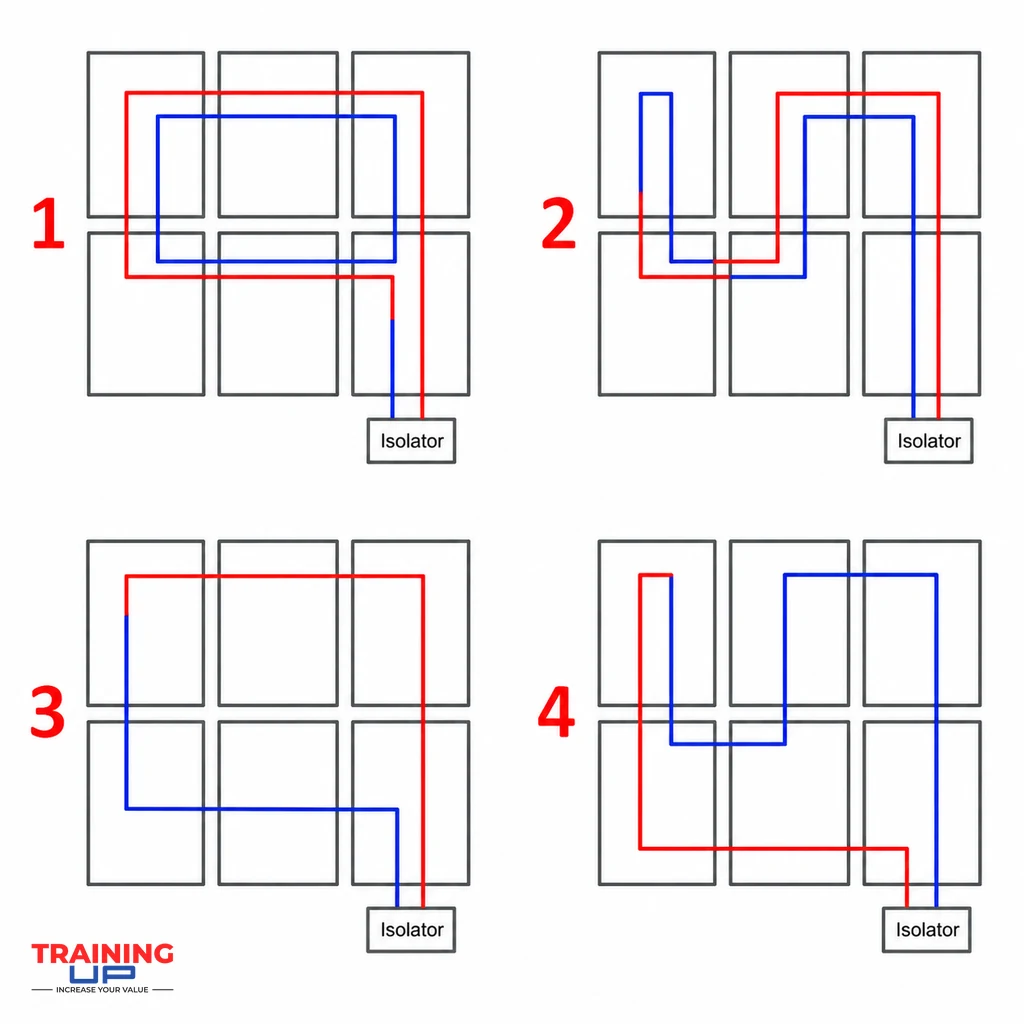
Choose 2 answers:
CorrectIncorrect -
Question 9 of 23
9. Question
Question 6
Identify the minimum required current carrying capacity of a string cable if it contains string overcurrent protection.
Select one:
CorrectIncorrect -
Question 10 of 23
10. Question
Question 7.1
The short circuit current of your modules is {9.5}A and they have a maximum series fuse rating of 25A.
Note that the inverter used does not produce any back-feed current.KI = 1
Using the value of the short circuit current given and a total number of {3} parallel strings, what is the minimum required CCC for string cables?
CorrectIncorrect -
Question 11 of 23
11. Question
Question 7.2
The short circuit current of your modules is {9.5}A and they have a maximum series fuse rating of 25A.
Note that the inverter used does not produce any back-feed current.KI = 1
You are installing an array with 4 parallel strings. Do you need string protection?
CorrectIncorrect -
Question 12 of 23
12. Question
Question 8
You are installing an array with {4} parallel strings, with {8} modules in each string. The short circuit current of each module is {8.7}A.
Calculate the minimum required CCC of your array cable.Select one:
CorrectIncorrect -
Question 13 of 23
13. Question
Question 9
If an array has 6 modules in series and the module Voc is {45.5}V, calculate the minimum voltage rating required for the DC cables.
The lowest expected cell temperature at the installation site is -2°C.
Select one:
CorrectIncorrect -
Question 14 of 23
14. Question
Question 10
What is the maximum allowable d.c. voltage drop for systems greater than 120 V?
Select one:
CorrectIncorrect -
Question 15 of 23
15. Question
Question 11
What standard must above-ground PV DC cables conform to?
Choose one:
CorrectIncorrect -
Question 16 of 23
16. Question
Question 12
According to Table 4.6 of AS/NZS 5033:2021, what would be the Earth conductor sizing for an array without d.c. overcurrent protection and a non-separated inverter with powered neutral, if the d.c. active conductor is 6mm2 and a.c. active conductor is 35 mm2? (Hint: Refer to Table 5.1 of AS/NZS 3000)
CorrectIncorrect -
Question 17 of 23
17. Question
Question 13
What is the minimum conductor cross-sectional area for both PV d.c. cables and earth conductors according to clause 4.4.2.3 and 4.6.5 from AS/NZS 5033:2021?
Choose one:
CorrectIncorrect -
Question 18 of 23
18. Question
Question 14.1
Consider the following diagram. The VOC of each module is {48}V and the ISC of each module is {11.1}A. The maximum series fuse rating for these modules is {20}A.
The lowest expected cell temperature at the installation site is 0°C.
The inverter is a separated inverter and the array is not functionally earthed. Using AS/NZS 5033:2021, complete the following questions:
Is fault current protection required?
CorrectIncorrect -
Question 19 of 23
19. Question
Question 14.2
Consider the following diagram. The VOC of each module is {48}V and the ISC of each module is {11.1}A. The maximum series fuse rating for these modules is {20}A.
The lowest expected cell temperature at the installation site is 0°C.The inverter is a separated inverter and the array is not functionally earthed. Using AS/NZS 5033:2021, complete the following questions:
Assuming string fault current protection was required, what would the minimum current rating be?
CorrectIncorrect -
Question 20 of 23
20. Question
Question 14.3
Consider the following diagram. The VOC of each module is {48}V and the ISC of each module is {11.1}A. The maximum series fuse rating for these modules is {20}A.
The lowest expected cell temperature at the installation site is 0°C.The inverter is a separated inverter and the array is not functionally earthed. Using AS/NZS 5033:2021, complete the following questions:
Assuming string fault current protection was required, what would the maximum current rating be?
CorrectIncorrect -
Question 21 of 23
21. Question
Question 14.4
Consider the following diagram. The VOC of each module is {48}V and the ISC of each module is {11.1}A. The maximum series fuse rating for these modules is {20}A.
The lowest expected cell temperature at the installation site is 0°C.The inverter is a separated inverter and the array is not functionally earthed. Using AS/NZS 5033:2021, complete the following questions:
Calculate the minimum current carrying capacity (CCC) of the string cable, assuming no fault current protection is installed.
CorrectIncorrect -
Question 22 of 23
22. Question
Question 14.5
Consider the following diagram. The VOC of each module is {48}V and the ISC of each module is {11.1}A. The maximum series fuse rating for these modules is {20}A.
The lowest expected cell temperature at the installation site is 0°C.The inverter is a separated inverter and the array is not functionally earthed. Using AS/NZS 5033:2021, complete the following questions:
Calculate the minimum current carrying capacity (CCC) of the array cable, assuming no fault current protection is installed.
CorrectIncorrect -
Question 23 of 23
23. Question
Question 14.6
Consider the following diagram. The VOC of each module is {48}V and the ISC of each module is {11.1}A. The maximum series fuse rating for these modules is {20}A.
The lowest expected cell temperature at the installation site is 0°C.The inverter is a separated inverter and the array is not functionally earthed. Using AS/NZS 5033:2021, complete the following questions:
What is the PV array maximum voltage? ____ V
CorrectIncorrect