Final Exam (Design & Install)
Time limit: 0
Quiz Summary
0 of 50 Questions completed
Questions:
Information
You have already completed the quiz before. Hence you can not start it again.
Quiz is loading…
You must sign in or sign up to start the quiz.
You must first complete the following:
Results
Quiz complete. Results are being recorded.
Results
0 of 50 Questions answered correctly
Your time:
Time has elapsed
You have reached 0 of 0 point(s), (0)
Earned Point(s): 0 of 0, (0)
0 Essay(s) Pending (Possible Point(s): 0)
Categories
- Not categorized 0%
- Review
- Answered
- Correct
- Incorrect
-
Question 1 of 50
1. Question
Question 1
Which of the following combinations (picture and description) shows the electrical set-up of a ‘string’ of modules?
Picture A: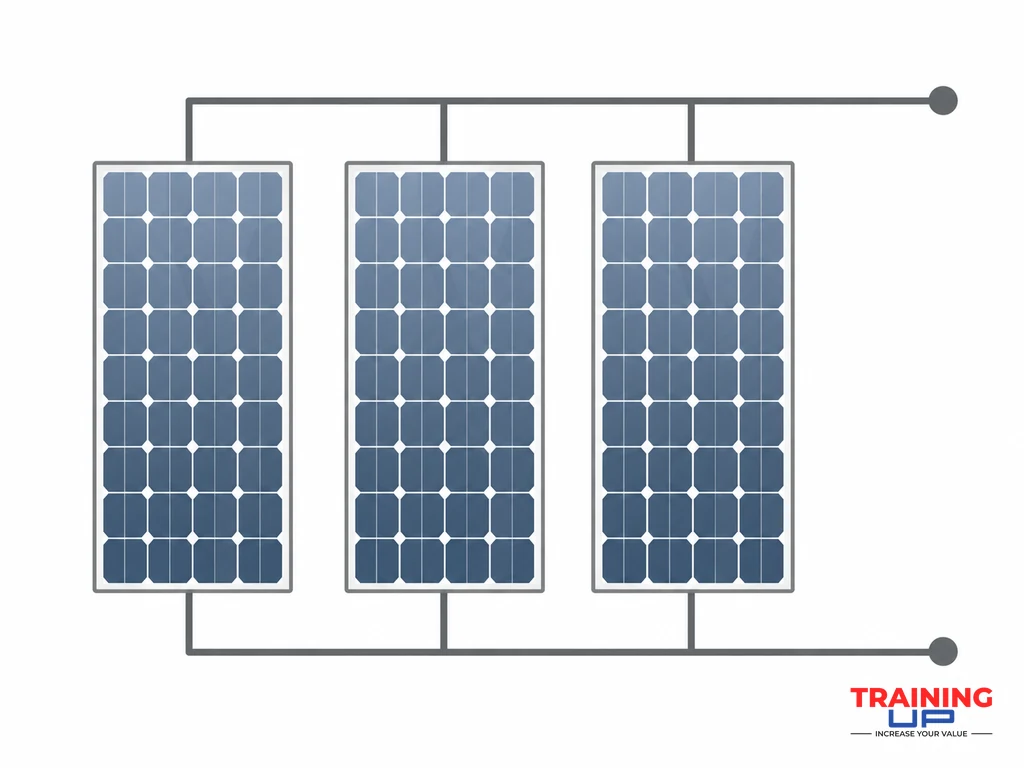
Picture B:

Description 1: a number of modules connected electrically in series
Description 2: a number of modules connected electrically in parallelSelect one:
CorrectIncorrect -
Question 2 of 50
2. Question
Question 2
Identify three environmental conditions that a module may experience that can affect its long term reliability and integrity.
Select all of the correct answers:
CorrectIncorrect -
Question 3 of 50
3. Question
Question 3
A potential customer wishes to feed 4800kWh per annum into the grid using a PV system. Answer the following questions, given the specifications below:
Module Power Rating: 210W
Module VMP: 28.9V
Module IMP:7.3A
Module VOC: 35.1V
Module ISC: 8.1A
Man. Tolerance (fmm):-3% to +5%
Average PSH at the site: 4.4PSH
Inverter Efficiency: 97%
Cable Losses: 2%
ftemp: 0.89
fdirt: 0.95What is the daily average energy yield of a single module?
CorrectIncorrect -
Question 4 of 50
4. Question
Question 3.2
A potential customer wishes to feed 4800kWh per annum into the grid using a PV system. Answer the following questions, given the specifications below:
Module Power Rating: 210W
Module VMP: 28.9V
Module IMP:7.3A
Module VOC: 35.1V
Module ISC: 8.1A
Man. Tolerance (fmm):-3% to +5%
Average PSH at the site: 4.4PSH
Inverter Efficiency: 97%
Cable Losses: 2%
ftemp: 0.89
fdirt: 0.95What is the average yearly energy yield for a single module?
-
kWh
CorrectIncorrect -
-
Question 5 of 50
5. Question
Question 3.3
A potential customer wishes to feed 4800kWh per annum into the grid using a PV system. Answer the following questions, given the specifications below:
Module Power Rating: 210W
Module VMP: 28.9V
Module IMP:7.3A
Module VOC: 35.1V
Module ISC: 8.1A
Man. Tolerance (fmm):-3% to +5%
Average PSH at the site: 4.4PSH
Inverter Efficiency: 97%
Cable Losses: 2%
ftemp: 0.89
fdirt: 0.95How many modules are required to fulfill the customer’s requirement of feeding 4800kWh into the grid?
-
modules
CorrectIncorrect -
-
Question 6 of 50
6. Question
Question 4
Select from the list below four specific things that you would perform when doing a site survey.
Select 4 correct answers:
CorrectIncorrect -
Question 7 of 50
7. Question
Question 5.1
An array comprises of a single string of 10 modules on a domestic dwelling with the characteristics as described below.
The cell temperature is expected to range from 0°C to 75°C.
The array is to be connected to an inverter with a MPPT voltage window of 150 – 400V, and a maximum input voltage of 750V DC.
Module Data:
Power Rating: 190W
VOC: 45.6V
ISC: 5.6A
VMP: 36.3V
IMP: 5.2A
VMP Temp. Coefficient: -0.45%/°C
VOC Temp. Coefficient: -0.32%/°C
Voltage Drop: 3%Based on this information, answer the following questions.
What is the minimum VMP of each module as seen by the inverter? Calculate to two decimal places. ___ V
CorrectIncorrect -
Question 8 of 50
8. Question
Question 5.2
An array comprises of a single string of 10 modules on a domestic dwelling with the characteristics as described below.
The cell temperature is expected to range from 0°C to 75°C.
The array is to be connected to an inverter with a MPPT voltage window of 150 – 400V, and a maximum input voltage of 750V DC.Module Data:
Power Rating: 190W
VOC: 45.6V
ISC: 5.6A
VMP: 36.3V
IMP: 5.2A
VMP Temp. Coefficient: -0.45%/°C
VOC Temp. Coefficient: -0.32%/°C
Voltage Drop: 3%Based on this information, answer the following questions.
Calculate the minimum inverter MPPT voltage with safety margin. ____ V
CorrectIncorrect -
Question 9 of 50
9. Question
Question 5.3
An array comprises of a single string of 10 modules on a domestic dwelling with the characteristics as described below.
The cell temperature is expected to range from 0°C to 75°C.
The array is to be connected to an inverter with a MPPT voltage window of 150 – 400V, and a maximum input voltage of 750V DC.Module Data:
Power Rating: 190W
VOC: 45.6V
ISC: 5.6A
VMP: 36.3V
IMP: 5.2A
VMP Temp. Coefficient: -0.45%/°C
VOC Temp. Coefficient: -0.32%/°C
Voltage Drop: 3%Based on this information, answer the following questions.
What is the minimum number of whole modules required in the string for this inverter? ____ modules
CorrectIncorrect -
Question 10 of 50
10. Question
Question 5.4
An array comprises of a single string of 10 modules on a domestic dwelling with the characteristics as described below.
The cell temperature is expected to range from 0°C to 75°C.
The array is to be connected to an inverter with a MPPT voltage window of 150 – 400V, and a maximum input voltage of 750V DC.Module Data:
Power Rating: 190W
VOC: 45.6V
ISC: 5.6A
VMP: 36.3V
IMP: 5.2A
VMP Temp. Coefficient: -0.45%/°C
VOC Temp. Coefficient: -0.32%/°C
Voltage Drop: 3%Based on this information, answer the following questions.
What is the maximum VOC of each module? Calculate to two decimal places. __ V
CorrectIncorrect -
Question 11 of 50
11. Question
Question 5.5
An array comprises of a single string of 10 modules on a domestic dwelling with the characteristics as described below.
The cell temperature is expected to range from 0°C to 75°C.
The array is to be connected to an inverter with a MPPT voltage window of 150 – 400V, and a maximum input voltage of 750V DC.Module Data:
Power Rating: 190W
VOC: 45.6V
ISC: 5.6A
VMP: 36.3V
IMP: 5.2A
VMP Temp. Coefficient: -0.45%/°C
VOC Temp. Coefficient: -0.32%/°C
Voltage Drop: 3%Based on this information, answer the following questions.
Calculate the maximum inverter input voltage at this site. ____ V
CorrectIncorrect -
Question 12 of 50
12. Question
Question 5.6
An array comprises of a single string of 10 modules on a domestic dwelling with the characteristics as described below.
The cell temperature is expected to range from 0°C to 75°C.
The array is to be connected to an inverter with a MPPT voltage window of 150 – 400V, and a maximum input voltage of 750V DC.Module Data:
Power Rating: 190W
VOC: 45.6V
ISC: 5.6A
VMP: 36.3V
IMP: 5.2A
VMP Temp. Coefficient: -0.45%/°C
VOC Temp. Coefficient: -0.32%/°C
Voltage Drop: 3%Based on this information, answer the following questions.
What is the maximum number of whole modules in series that you should connect to this inverter? ____ modules
CorrectIncorrect -
Question 13 of 50
13. Question
Question 5.7
An array comprises of a single string of 10 modules on a domestic dwelling with the characteristics as described below.
The cell temperature is expected to range from 0°C to 75°C.
The array is to be connected to an inverter with a MPPT voltage window of 150 – 400V, and a maximum input voltage of 750V DC.Module Data:
Power Rating: 190W
VOC: 45.6V
ISC: 5.6A
VMP: 36.3V
IMP: 5.2A
VMP Temp. Coefficient: -0.45%/°C
VOC Temp. Coefficient: -0.32%/°C
Voltage Drop: 3%Based on this information, answer the following questions.
Is this array, formed of a single string with 10 modules, suitable to be connected to the inverter under the given operating conditions? Yes/No?
CorrectIncorrect -
Question 14 of 50
14. Question
Question 6.1
You are designing a commercial system using 330 W Jinko Eagle 72P polycrystalline modules [datasheet], at a site with minimum expected temperature of -2ºC. Your design has 2 strings with 12 modules in each string, and a transformerless inverter. The system design requires one isolator adjacent to the array, after the strings have been paralleled, and another isolator adjacent to the inverter in the basement.
There are three isolator models to choose from:
– IMO SI16
– IMO SI25
– PGK1500Calculate:
The maximum array voltage: ____ V
CorrectIncorrect -
Question 15 of 50
15. Question
Question 6.2
You are designing a commercial system using 330 W Jinko Eagle 72P polycrystalline modules [datasheet], at a site with minimum expected temperature of -2ºC. Your design has 2 strings with 12 modules in each string, and a transformerless inverter. The system design requires one isolator adjacent to the array, after the strings have been paralleled, and another isolator adjacent to the inverter in the basement.
There are three isolator models to choose from:
– IMO SI16
– IMO SI25
– PGK1500Calculate:
The minimum current carrying capacity of the array cable: ____ A
CorrectIncorrect -
Question 16 of 50
16. Question
Question 6.3
You are designing a commercial system using 330 W Jinko Eagle 72P polycrystalline modules [datasheet], at a site with minimum expected temperature of -2ºC. Your design has 2 strings with 12 modules in each string, and a transformerless inverter. The system design requires one isolator adjacent to the array, after the strings have been paralleled, and another isolator adjacent to the inverter in the basement.
There are three isolator models to choose from:
– IMO SI16
– IMO SI25
– PGK1500Choose:
What is the smallest isolator to be used in this design ?
CorrectIncorrect -
Question 17 of 50
17. Question
Question 6.4
You are designing a commercial system using 330 W Jinko Eagle 72P polycrystalline modules [datasheet], at a site with minimum expected temperature of -2ºC. Your design has 2 strings with 12 modules in each string, and a transformerless inverter. The system design requires one isolator adjacent to the array, after the strings have been paralleled, and another isolator adjacent to the inverter in the basement.
There are three isolator models to choose from:
– IMO SI16
– IMO SI25
– PGK1500Choose:
The client decided to add a third string to this system, what is the smallest isolator for this design ?
CorrectIncorrect -
Question 18 of 50
18. Question
Question 6.5
You are designing a commercial system using 330 W Jinko Eagle 72P polycrystalline modules [datasheet], at a site with minimum expected temperature of -2ºC. Your design has 2 strings with 12 modules in each string, and a transformerless inverter. The system design requires one isolator adjacent to the array, after the strings have been paralleled, and another isolator adjacent to the inverter in the basement.
There are three isolator models to choose from:
– IMO SI16
– IMO SI25
– PGK1500Choose:
Instead of adding an extra string, you convinced the client to use 2 strings of 18 modules each, for lower voltage drop. What is the smallest isolator for this design ?
CorrectIncorrect -
Question 19 of 50
19. Question
Question 7.1
You are provided with a location for an installation in southern Victoria, of latitude 39.4°. What is the altitude of the Sun at solar noon, when the Sun is located over the Tropic of Capricorn (Summer Solstice)? In your answer include 2 decimal figures. ___°
CorrectIncorrect -
Question 20 of 50
20. Question
Question 7.2
For this installation, what tilt angle for the modules would get the best performance at solar noon during the Summer Solstice? Round to the nearest whole degree. ____°
CorrectIncorrect -
Question 21 of 50
21. Question
Question 8
A typical grid-connected PV system may experience power losses across its operational lifetime. Select from the list below five typical sources of power loss.
Choose FIVE correct answers:
CorrectIncorrect -
Question 22 of 50
22. Question
Question 9
From the options below, select the correct safety-related and performance-related issues that need to be considered when matching an array and inverter.
CorrectIncorrect -
Question 23 of 50
23. Question
Question 10
Choose from the list below two extra pieces of PPE that the person in the photo below requires:
Choose TWO correct answers:
 CorrectIncorrect
 -
Question 24 of 50
24. Question
Question 11
When climbing a roof to perform an installation, safety equipment must be used. The list below includes safety equipment, but only a few are appropriate during a rooftop installation. Select the correct pieces of safety equipment from the list.
Choose FOUR correct answers:
CorrectIncorrect -
Question 25 of 50
25. Question
Question 12
You are about to undertake an installation of a photovoltaic system on a house with a metal tin roof. From the list below, what would you do before you start the installation?
Select all of the correct answers:
CorrectIncorrect -
Question 26 of 50
26. Question
Question 13
A customer has phoned to say that his grid-connected PV system is not working. He informs you that there have been recent storms and currently they have no mains power. His primary concern is that lightning may have struck his array.
From the list below, which should you advise the customer do?CorrectIncorrect -
Question 27 of 50
27. Question
Question 14
Select six items of documentation from the list below that must be included with the system manual.
Select 6 correct answers:
CorrectIncorrect -
Question 28 of 50
28. Question
Question 15.1
A customer has a roof section that is 8.2m x 5.5m. They wish to fill this area with 180W modules. The modules are 1.3 x 1.0m (including spacing for installation and edge zones). What is the maximum number of modules they can fit on the roof assuming there are no site specific wind loading issues?
Compare both portrait and landscape orientations. Image not to scale.
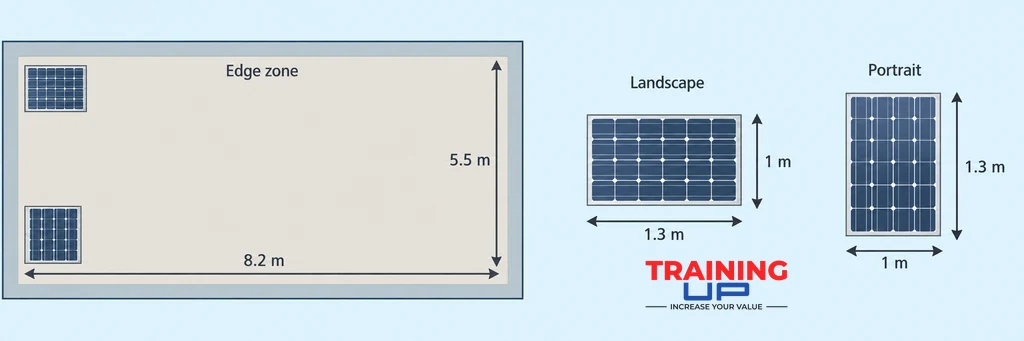
Calculate maximum number of modules in portrait orientation
-
modules
CorrectIncorrect -
-
Question 29 of 50
29. Question
Question 15.2
A customer has a roof section that is 8.2m x 5.5m. They wish to fill this area with 180W modules. The modules are 1.3 x 1.0m (including spacing for installation and edge zones). What is the maximum number of modules they can fit on the roof assuming there are no site specific wind loading issues?
Compare both portrait and landscape orientations. Image not to scale.
Calculate maximum number of modules in landscape orientation
-
modules
CorrectIncorrect -
-
Question 30 of 50
30. Question
Question 16
Select from below one advantage and one disadvantage of tilting the modules up off the roof on a raised structure.
Select 2 correct answers:
CorrectIncorrect -
Question 31 of 50
31. Question
Question 17
In the performance of a site survey, hazards should be noted and a safety measure should be planned for each hazard. Select from the list below the expected hazards of a typical residential site and select their corresponding safety measure.
CorrectIncorrect -
Question 32 of 50
32. Question
Question 18
Select from below four maintenance activities that should be conducted annually on a solar array.
Choose FOUR correct answers:
CorrectIncorrect -
Question 33 of 50
33. Question
Question 19
You are about to undertake a design of a photovoltaic system on a house with a tile roof. From the list below, what would you do before you start the design?
Choose FIVE correct answers:
CorrectIncorrect -
Question 34 of 50
34. Question
Question 20.1
You are given 12 modules each having 4.5A current rating and 24V voltage rating. What is the best combination to connect them in a circuit to get 144V as the output voltage of the electrical circuit.
Choose number of modules in series:
CorrectIncorrect -
Question 35 of 50
35. Question
Question 20.2
You are given 12 modules each having 4.5A current rating and 24V voltage rating. What is the best combination to connect them in a circuit to get 144V as the output voltage of the electrical circuit.
Choose number of strings in parallel:
CorrectIncorrect -
Question 36 of 50
36. Question
Question 20.3
You are given 12 modules each having 4.5A current rating and 24V voltage rating. What is the best combination to connect them in a circuit to get 144V as the output voltage of the electrical circuit. Also calculate the output current and power of this combination.
Choose output current of the circuit:
CorrectIncorrect -
Question 37 of 50
37. Question
Question 20.4
You are given 12 modules each having 4.5A current rating and 24V voltage rating. What is the best combination to connect them in a circuit to get 144V as the output voltage of the electrical circuit. Also calculate the output current and power of this combination.
Choose output power of the circuit:
CorrectIncorrect -
Question 38 of 50
38. Question
Question 21
A compliant grid-connected PV installation must follow particular standards. Select from the list below the correct standards that relate to grid-connected PV.
Choose FOUR correct answers:
CorrectIncorrect -
Question 39 of 50
39. Question
Question 22.1
From the list below select the correct sequence of events for shutdown procedures for a small grid-Connect system.
CorrectIncorrect -
Question 40 of 50
40. Question
Question 22.2
From the list below select the correct sequence of events for start-up procedures for a small grid-Connect system.
CorrectIncorrect -
Question 41 of 50
41. Question
Question 23.1
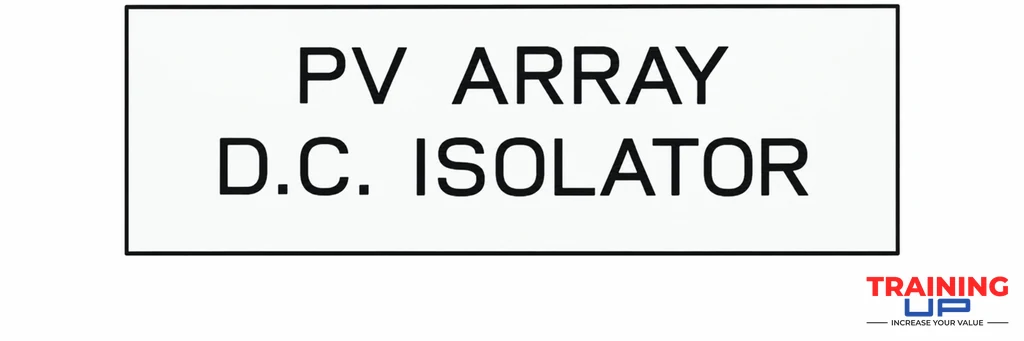
Any grid-connected PV installation requires specific signage to be installed in particular locations. The images below represent signs compliant to AS/NZS 5033:2021. Select the correct locations for the signs below.
1.
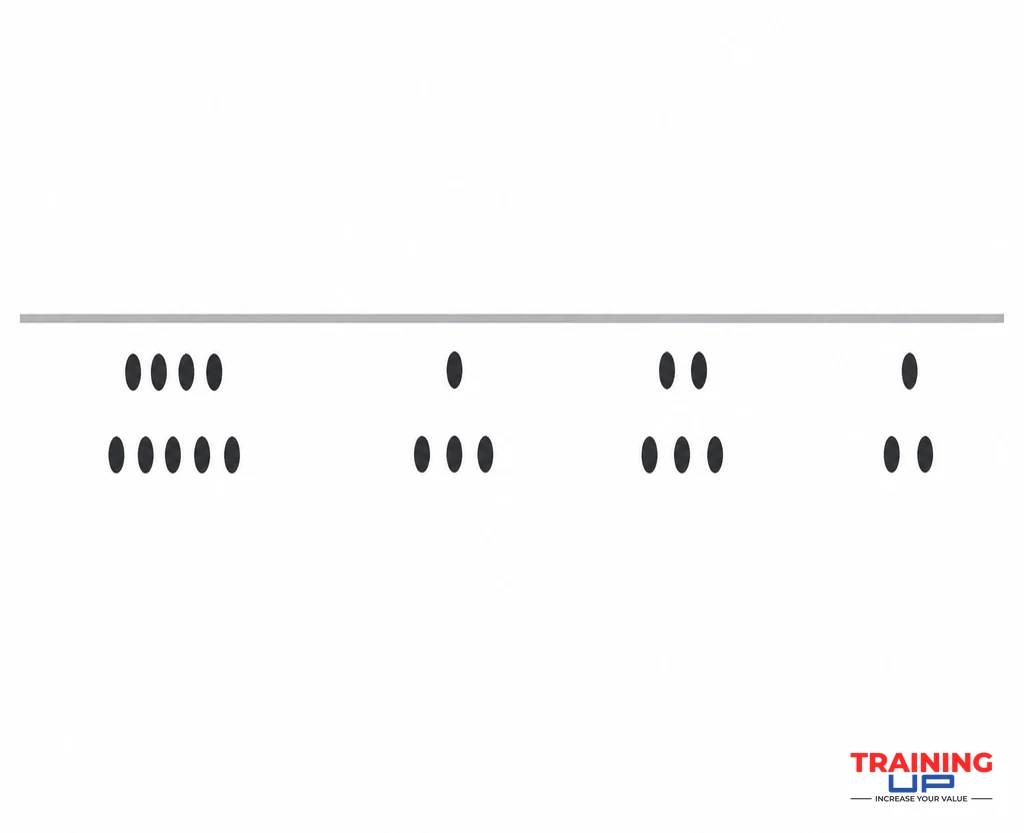
2.
 CorrectIncorrect
 -
Question 42 of 50
42. Question
Question 23.2
Any grid-connected PV installation requires specific signage to be installed in particular locations. The images below represent signs compliant to AS/NZS 5033:2021. Select the correct locations for the signs below.
CorrectIncorrect -
Question 43 of 50
43. Question
Question 24
If a solar module has a max series fuse rating of 18A and an ISC of 6.2A, would you require string fusing on an array with 3 parallel strings?
Select one:
CorrectIncorrect -
Question 44 of 50
44. Question
Question 25.1
Module Data:
ISC 9.28A
VOC 38.3V
IMP 8.77A
VMP 30.8V
PMAX 270W
Max series fuse rating 20A
VOC temperature coefficient -0.34%/°C
Minimum expected cell temperature -5°C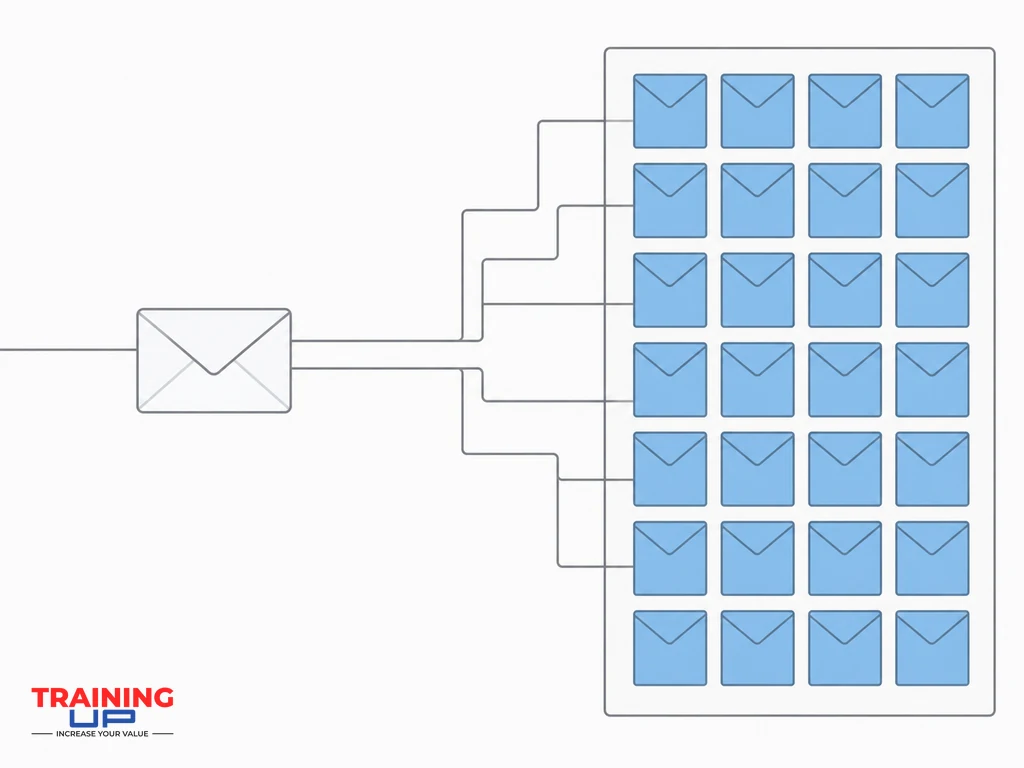
The array is a rooftop array and the inverter is located on the east wall of the house.
Note that the inverter is non-separated, and the array is not functionally earthed.Based on the module data and system diagram provided, answer the following questions:
Does this system require string overcurrent protection?
Yes/NoCorrectIncorrect -
Question 45 of 50
45. Question
Question 25.2
Module Data:
ISC 9.28A
VOC 38.3V
IMP 8.77A
VMP 30.8V
PMAX 270W
Max series fuse rating 20A
VOC temperature coefficient -0.34%/°C
Minimum expected cell temperature -5°CThe array is a rooftop array and the inverter is located on the east wall of the house.
Note that the inverter is non-separated, and the array is not functionally earthed.Based on the module data and system diagram provided, answer the following questions:
Taking into account what you put in the question above, determine the rating for the string cable fuse protection. Calculate to two decimal places.
CorrectIncorrect -
Question 46 of 50
46. Question
Question 25.3
Module Data:
ISC 9.28A
VOC 38.3V
IMP 8.77A
VMP 30.8V
PMAX 270W
Max series fuse rating 20A
VOC temperature coefficient -0.34%/°C
Minimum expected cell temperature -5°CThe array is a rooftop array and the inverter is located on the east wall of the house.
Note that the inverter is non-separated, and the array is not functionally earthed.Based on the module data and system diagram provided, answer the following questions:
What is the maximum fuse rating?
CorrectIncorrect -
Question 47 of 50
47. Question
Question 25.4
Module Data:
ISC 9.28A
VOC 38.3V
IMP 8.77A
VMP 30.8V
PMAX 270W
Max series fuse rating 20A
VOC temperature coefficient -0.34%/°C
Minimum expected cell temperature -5°CThe array is a rooftop array and the inverter is located on the east wall of the house.
Note that the inverter is non-separated, and the array is not functionally earthed.Based on the module data and system diagram provided, answer the following questions:
What should the current carrying capacity of the string cables be?
CorrectIncorrect -
Question 48 of 50
48. Question
Question 25.5
Module Data:
ISC 9.28A
VOC 38.3V
IMP 8.77A
VMP 30.8V
PMAX 270W
Max series fuse rating 20A
VOC temperature coefficient -0.34%/°C
Minimum expected cell temperature -5°CThe array is a rooftop array and the inverter is located on the east wall of the house.
Note that the inverter is non-separated, and the array is not functionally earthed.Based on the module data and system diagram provided, answer the following questions:
In which of the following locations would you install the string overcurrent protection?
CorrectIncorrect -
Question 49 of 50
49. Question
Question 25.6
Module Data:
ISC 9.28A
VOC 38.3V
IMP 8.77A
VMP 30.8V
PMAX 270W
Max series fuse rating 20A
VOC temperature coefficient -0.34%/°C
Minimum expected cell temperature -5°CThe array is a rooftop array and the inverter is located on the east wall of the house.
Note that the inverter is non-separated, and the array is not functionally earthed.Based on the module data and system diagram provided, answer the following questions:
Choose the current carrying capacity for the array cable.
CorrectIncorrect -
Question 50 of 50
50. Question
Question 25.7
Module Data:
ISC 9.28A
VOC 38.3V
IMP 8.77A
VMP 30.8V
PMAX 270W
Max series fuse rating 20A
VOC temperature coefficient -0.34%/°C
Minimum expected cell temperature -5°CThe array is a rooftop array and the inverter is located on the east wall of the house.
Note that the inverter is non-separated, and the array is not functionally earthed.Based on the module data and system diagram provided, answer the following questions:
In which of the following locations would you install the PV array DC isolator?
CorrectIncorrect